Three "best model" headlines in three weeks. Your workflow shouldn't have to follow.
TL;DR
The frontier changed hands three times in September 2026. Chasing the leader with a single subscription resets your context every time. In a Bordet boardroom every model gets a seat with a role; when a new leader lands you swap the model behind the seat in two clicks while the shared memory, decisions log and teammates stay put.
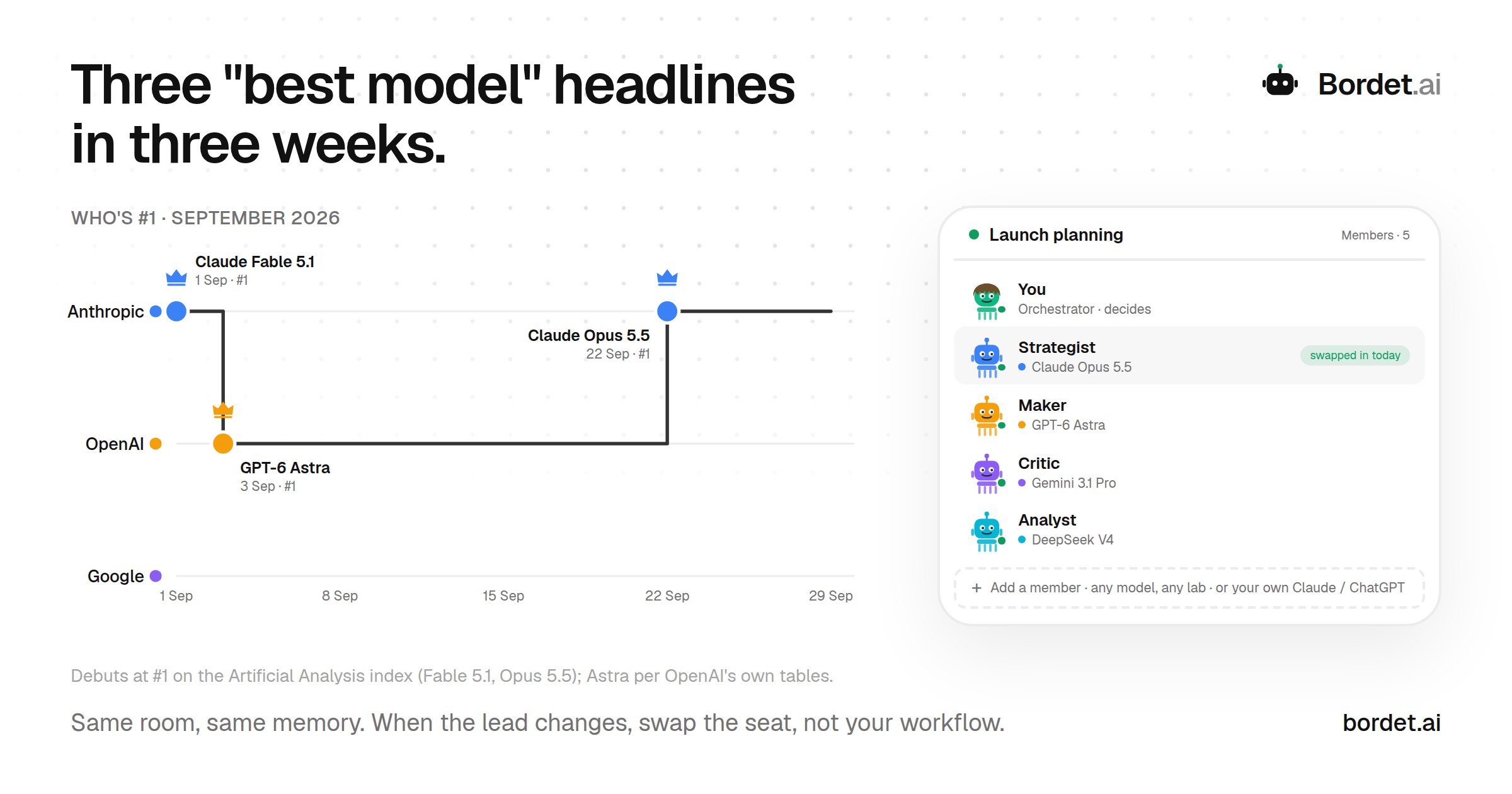
If you have been anywhere near AI news this month, you have watched the crown change hands three times.
On 1 September Anthropic shipped Claude Fable 5.1 and it debuted at the top of the Artificial Analysis Intelligence Index. Two days later OpenAI answered with GPT-6 Astra, and its own benchmark tables put Astra ahead almost everywhere, while the independent evaluators still had Fable 5.1 in front, so the comparison threads argued about it for a fortnight. Then, on 22 September, Claude Opus 5.5 arrived and debuted at number one, ahead of both.
Three weeks. Three "this is the one to use now" moments. And if you were only going to keep one subscription, three chances to feel you had picked wrong.
The subscription treadmill
That is what the leaderboard rhythm turns into for most people: a quiet tax. Subscribe to the leader. Move your prompts, your habits and your half-remembered project context across. Get comfortable. Read a benchmark thread at midnight and wonder whether it is time to switch again. Either the subscriptions pile up, or you keep switching and every switch resets the relationship you had built with the last model: the project it knew, the way you had learned to brief it, the decisions you had already talked through.
It is also the wrong question, because "best model" has quietly become "best at what". This month's headlines were about a single intelligence index. Ask instead who writes the cleanest code, who is the most useful sceptic when your plan is weak, who is good enough for a first draft at a tenth of the price, and you get three different names. Picking one winner means paying for the strongest model on one axis and accepting its weaknesses on all the others. Anyone who works with these tools seriously already knows this, which is why so many of us end up with three tabs open, couriering context between them by hand.
Seats, not subscriptions
Bordet starts from the other direction. A boardroom in Bordet is a set of seats, each with a role: a Strategist who owns direction, a Maker who produces the work, a Critic whose job is to find the hole, an Analyst, a Researcher, whatever your project needs. Behind each seat sits a model, and that model can be whichever one you want, from whichever lab. Claude, GPT, Gemini, Grok, DeepSeek, Mistral, Llama, side by side in the same conversation, reading each other and disagreeing when they should.
When the lead changes hands, you change the model behind a seat. Two clicks in the members list. On 1 September your Strategist could be Fable 5.1; on the 3rd you could hand the seat to Astra to see whether OpenAI's tables were right; on the 22nd you could give it to Opus 5.5. Nothing else moves. The room keeps its shared memory of your project. The decisions log, an append-only record of what you decided and why, keeps every entry. Your teammates are still in the room. The other seats still know what the Strategist said last week, because that knowledge belongs to the table, not to the model that happened to be sitting there.
That is the difference between a subscription and a seat. A subscription ties your work to one lab's release calendar. A seat ties your work to your project, and lets the models come and go.
What it looks like in practice
Say you are planning a launch. You put the question to the whole table and get three answers in parallel: one model argues for a long, careful rollout, another says ship now and fix in public, a third asks what you are actually optimising for before either plan is worth discussing. They read each other and push back. You decide, and the decision lands in the log. Then Opus 5.5 ships and you want its read: drop it into the Strategist seat, ask it to review the plan, and it starts from the decisions log rather than from zero. Nothing is re-explained. Nothing is lost.
If you are a developer, the same idea extends to your coding agent. Claude Code or Codex can take a seat at the table, ask the board before an irreversible choice, do the work in your repo and log what it did.
You do not need to bring API keys
Bordet works two ways. Most people start with credits: load a few dollars and every model at the table is available immediately, including the ones that shipped this week, metered per turn, with the balance as a hard cap so there is never a surprise. If you already have API keys, bring them and pay the labs directly with no markup. And if you already pay for Claude or ChatGPT, connect that AI to a boardroom as a member and let it do the thinking while the table remembers.
There is no single subscription to keep switching between, because there is nothing to switch. Everything is already at the table.
The labs will keep leapfrogging each other, probably faster than this month. That is good news, as long as your work is not welded to whichever one is ahead this week. Open a boardroom, give each seat a role, and put all of them to work.
See it for yourself
Open a multi-LLM boardroom and put your AI team to work.