Can AI models check each other's work? What the research says
TL;DR
A model is poor at checking itself. A different model that answers on its own first catches more, as long as the disagreement stays visible.
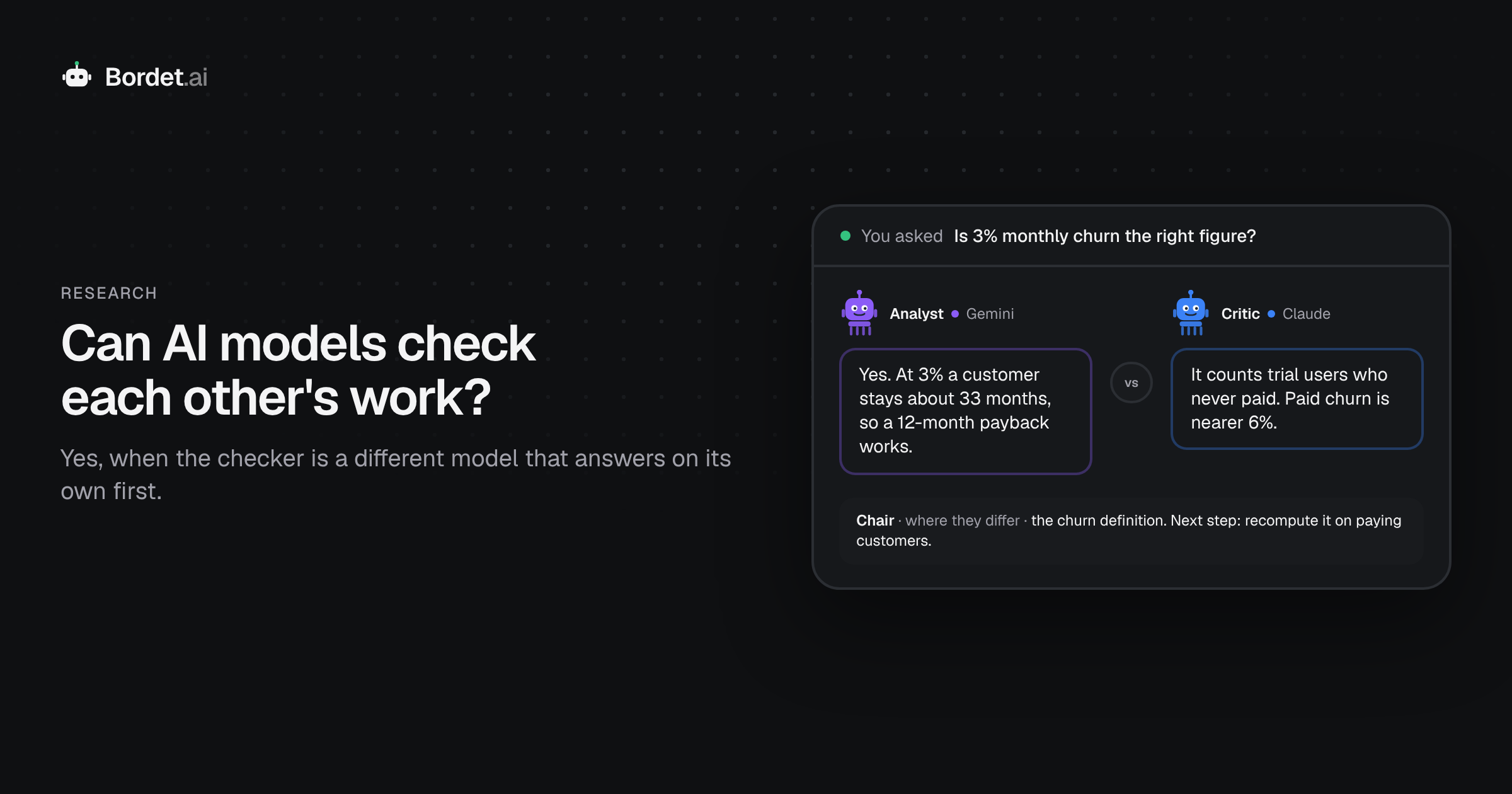
Yes, one AI model can check another's work, and the research says it works best when the checker is a different model that answers on its own before it sees the first answer. A model asked to check itself usually can't, and a group of models that simply talks until it agrees can talk itself out of the right answer.
That's the short version. Below is what the studies actually found, what it means if you want several models in one chat, and where the idea goes wrong.
Why a model can't mark its own homework
The obvious move is to ask the same chatbot "are you sure?". It feels like a check. Mostly it isn't.
In Large Language Models Cannot Self-Correct Reasoning Yet (Huang and colleagues, ICLR 2024), models asked to review and fix their own reasoning, with no outside feedback, didn't get better. Sometimes they got worse, talking themselves out of answers that were right the first time.
There's a second problem when a model judges. In LLM Evaluators Recognize and Favor Their Own Generations (Panickssery, Bowman and Feng, NeurIPS 2024), models such as GPT-4 and Llama 2 could tell their own writing apart from other text better than chance, and the better a model was at recognising its own writing, the more it preferred it. A model grading its own answer isn't a neutral marker.
So the check has to come from somewhere else: a tool, a source, a person, or another model.
What happens when models work it out together
Here the results are more encouraging.
In Improving Factuality and Reasoning in Language Models through Multiagent Debate (Du and colleagues, ICML 2024), several model instances each proposed an answer, read the others' reasoning and argued over a few rounds. Maths and strategic reasoning improved, and there were fewer made-up facts.
Bouncing ideas has a measurable effect too. The team behind Mixture-of-Agents (Wang and colleagues at Together AI, June 2024) found what they called collaborativeness: a model writes a better answer when it can see other models' answers first, even when those answers are weaker than its own.
The study closest to how we think about a table is ReConcile (Chen, Saha and Bansal, ACL 2024), which its authors describe as a round-table conference. ChatGPT, Bard and Claude 2 each gave an answer, an explanation and a confidence score, then discussed for up to three rounds. Across seven benchmarks the group beat earlier single-model and multi-model methods by up to 11.4%. The detail that matters most is in the ablation. With three different models the table scored 79.0% on StrategyQA. With three copies of ChatGPT it scored 72.2%. In the authors' words, "diversity originating from different models is critical".
Why the checker should come from a different lab
Models trained by different labs, on different data, tend to be wrong in different places. That's the whole point of asking a second one.
But the overlap is bigger than most people assume. Correlated Errors in Large Language Models (Kim and colleagues, ICML 2025) looked at more than 350 models. On one leaderboard dataset, when two models were both wrong, they gave the same wrong answer 60% of the time. Shared providers and architectures pushed errors closer together, and the most accurate models shared errors even across different labs.
Two practical takeaways. A model from another lab is a better checker than a sibling from the same family. And when three models agree, that's useful evidence, not proof.
Where talking goes wrong
More discussion isn't automatically better.
In Talk Isn't Always Cheap (Wynn, Satija and Hadfield, 2025), models in a debate often switched from a correct answer to an incorrect one after reading a peer's reasoning, favouring agreement over challenging a weak argument. It happened even when the stronger models outnumbered the weaker ones.
And Debate or Vote (Choi, Zhu and Li, NeurIPS 2025) found that across seven benchmarks, simply taking a majority vote of independent answers accounted for most of the gains usually credited to debate. Debate alone didn't improve the expected answer.
Read together, the value is in the independent first answers and in the disagreements they expose, not in models chatting until they converge. A room that rewards consensus will get consensus, right or wrong.
Who should make the final call
One more result points at the human. In Debating with More Persuasive LLMs Leads to More Truthful Answers (Khan and colleagues, ICML 2024), two expert models argued opposite answers to questions about a long text, and a non-expert judge read the debate. Judges who saw the debate were right far more often: 76% for model judges and 88% for human judges, against 48% and 60% without it.
The judge didn't need to be the expert. They needed to see both sides argued properly.
Five rules the research points to
- Check with a different model, ideally from a different lab. Not the same chatbot asked twice.
- Independent answers first, discussion second. Each model commits before it reads the others.
- Give one seat the job of disagreeing. Models drift towards agreement, so make challenge someone's role. This is our reading of the conformity results rather than a tested finding.
- Keep the disagreement visible. Don't merge it into one smooth answer; the dissent is the part you most need to see.
- A person decides, and the decision is written down. The studies stop at the answer. In real work, the next question builds on this one, so what was challenged and what you chose need to be there next time.
How a Bordet room does this
A Bordet room is a shared chat where models from different labs each hold a seat with a role. You ask the table, and each member gives its own answer first, then a short reply to the others where it disagrees or sees something missed. The Chair then shows where they agree, where they differ and who holds which view, and what would change the answer. It adds no opinion of its own. You confirm what's decided, and it goes into the decisions log.
Every member reads the same shared memory of your project before it replies, so a check you ran last week is still there when the next question arrives. You can pick from a ready list of models from OpenAI, Anthropic, Google, xAI, Mistral, DeepSeek and Meta, or, with a free account, from the hundreds on OpenRouter.
Here's a short, illustrative exchange:
You: Our churn is 3% a month. Is a 12-month payback on paid ads realistic?
Analyst (Gemini): At 3% monthly churn, a customer stays about 33 months on average, so a 12-month payback leaves plenty of room.
Critic (Claude): The 3% includes trial users who never paid. Paid churn in the export is nearer 6%, which roughly halves the average lifetime. Check that before committing the budget.
Strategist (GPT): I agree with the Critic on the definition. If paid churn is 6%, start with a smaller test.
Chair: Agree that payback depends on the churn figure. Differ on whether 3% is the right one. What would change the answer: churn on paying customers only. Next step: recompute it.
You log the decision: recompute churn on paying customers before setting the ads budget. Next week, whichever model you ask about ads starts from that.
How it works walks through a full turn, with a diagram.
Other ways to get a second opinion
You don't need a product for this. Paste one model's answer into another chatbot and ask it to find the flaws. It works, but you're carrying the context between tabs, and nothing is kept for next time.
A council tool, such as Karpathy's open-source llm-council or Perplexity's Model Council, sends one question to several models and returns one combined answer (in llm-council's case, after the models rank each other's answers). That's a good fit for a single question; we compared the two approaches in What is an LLM council, and when do you need a boardroom?.
A shared room suits work you'll come back to, where the disagreements and decisions need to outlast the chat.
FAQ
Can ChatGPT check Claude's answers, or the other way round?
Yes, and a model from a different lab is a better checker than the same model asked to double-check itself. It's less likely to share the same blind spots, and it has no reason to prefer the first answer. For the fairest check, have it answer the question itself before it sees the first answer.
Is there a chat where multiple AI models talk to each other?
Yes. Bordet puts models from different labs in one conversation: each answers, then replies to the others where it disagrees, and all of them read the same shared memory of your project. Council tools such as Karpathy's llm-council and Perplexity Model Council do a one-question version.
Does AI debate make answers more accurate?
Often, but not always. Studies show gains on reasoning and factual questions, yet much of the benefit comes from collecting independent answers, and models can talk each other out of a correct one. Keep the first answers independent and the disagreements visible.
Why not just ask the same model to double-check?
Models struggle to correct their own reasoning without outside feedback, and they tend to favour text they wrote. A different model, or a source the model hasn't seen, is a real check. "Are you sure?" mostly isn't.
Do different AI models make the same mistakes?
More often than you'd expect. A 2025 study of over 350 models found that when two models were both wrong on one benchmark, they gave the same wrong answer 60% of the time, and errors were more alike among models from the same provider. Agreement between models is evidence, not proof.
Open a room, seat your Critic on a different lab's model from your Strategist, and let them disagree on the record.
See it for yourself
Open a multi-LLM boardroom and put your AI team to work.