Gemini 4 Argon can write. Give it a seat, not your whole workflow.
TL;DR
Gemini 4 Argon is winning praise for its writing. In a Bordet room you add it as the Writer and keep Claude and GPT in the seats they already hold.
You've finally got a set-up that works. Claude is the one you trust with the code. GPT is the one you argue with when a plan looks too tidy. You know how to brief each of them, and you've stopped thinking about it.
Then a new model lands, and everyone says it writes better than anything else.
On 30 September Google announced Gemini 4 Argon, and on 13 October it opened it to developers and paying Gemini subscribers. The word that keeps coming up is writing. Google says Argon "follows style instructions better than any of our previous Gemini models" and avoids clichés. Techzine's verdict on 14 October was that "Argon is a strong writer, but its coding style is divisive". And in early October it led Arena's blind creative-writing vote.
So the old question comes back. Do you move?
Best at writing is not best at everything
Look closer and the picture is more interesting than the headline.
On Arena's creative-writing leaderboard, as of its 15 October update, Argon is second: 1,516 points to Claude Opus 5.5's 1,519, on a preliminary rating, with error bars that overlap. "Best writer" is a three-point argument that has already changed hands once. On the Artificial Analysis Intelligence Index, the broad measure across reasoning, knowledge and code, Argon ranks eighth. And as Techzine put it, its code divides opinion.
None of that makes Argon a weak model. It makes it a specialist. Which is how most people already use AI: one model for the code, one for the sceptical read, and now perhaps one for the first draft. "Best model" has quietly turned into "best at what".
The trouble is what happens next. Either you move everything to the new writer (your projects, your prompts, the context you spent weeks building up), or you add another subscription and another tab and go back to pasting the brief from one window into the next. You become the courier.
Add a seat. Keep the table.
In a Bordet room, a new specialist is a new seat, not a migration.
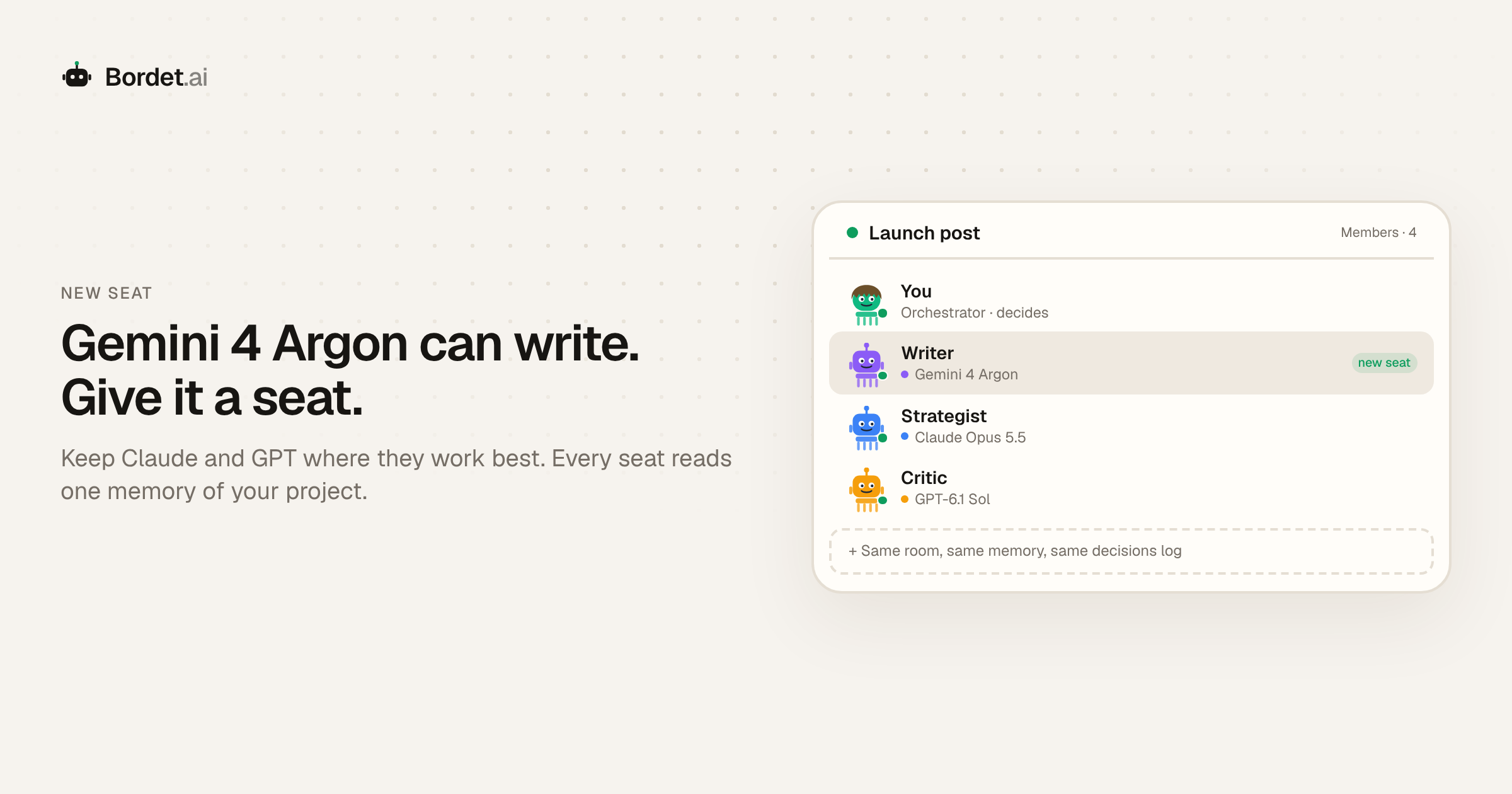
Open the members list, add a seat called Writer and pick Gemini 4 Argon. That's it. Claude keeps the seat it already holds. GPT is still the Critic. Nobody moves.
The new member arrives knowing the project, because that knowledge doesn't live in any one model. It lives in the room: the board with your objective and open questions, the sources you've added, and the decisions log, an append-only record of what you decided and why. Every member reads it before every reply. So Argon's first draft starts from the positioning you settled last week, not from a blank page and a paragraph of context you had to retype.
The others keep doing their jobs, too. Each member gives its own answer, then replies to the others where it disagrees. The Chair sums up where they agree, where they don't and what is left to decide. You make the call.
What it looks like in practice
Say you're launching a feature on Thursday and need the announcement.
You ask the table. Argon, in the Writer seat, drafts it. The draft is saved with its versions, so you ask its author for changes instead of copying text between windows.
Claude, as Strategist, points out that the second paragraph promises an integration you decided not to ship. It's right there in the decisions log, dated last Tuesday. GPT, as Critic, says the headline is written for the team, not the customer. Argon takes both notes and writes version two.
You read it, change one line, and log the decision: lead with the customer's problem, not the feature name.
Curious whether Claude Opus 5.5 would write it better? Seat it as a second Writer and ask both. Arena has them three points apart. Your readers are the only vote that counts.
Keep what you already pay for
If you already pay for Claude or ChatGPT and like working there, keep doing that. You can connect your AI as a member through the MCP connector, so it sits at the same table, reads the same room and logs decisions alongside the models you've seated. Claude Code, Codex and Cursor can join the same way.
The models you seat in Bordet run on credits. It's free to try, new accounts get a starting credit, and after that you buy prepaid credits, metered per turn, with the balance as a hard cap. Or bring your own API keys, Google's included, and pay the labs directly; that's free in beta. The current numbers are on the pricing page.
The next specialist is already on its way
Argon won't be the last model that's best at one thing. Next month it might be a sharper coder, a cheaper analyst or a better sceptic. Each time, the question can be "which seat?" rather than "do I switch?"
Open a boardroom, give Gemini 4 Argon the Writer seat, and keep everyone else where they are.
See it for yourself
Open a multi-LLM boardroom and put your AI team to work.