A council is a query. A boardroom is a place.
TL;DR
Multi-model councils answer one question and end. A boardroom keeps the seats, the memory and the decisions log after the answer.
On 5 February, Perplexity introduced Model Council: one question goes to three frontier models at once, and a synthesising model shows where they agree and where they differ. On 30 March, Microsoft announced a Model Council in the Researcher agent in Microsoft 365 Copilot, with a side-by-side comparison of answers from different models, next to a feature called Critique in which Claude reviews answers drafted by GPT.
Asking more than one model has gone from a power-user habit to a product line. We think that is the right call, and we have said so since the start. Perplexity's own reasoning is hard to argue with: when models agree you can move faster, and when they disagree you should look harder.
So the question is no longer whether to ask several models. It is what happens after you do.
The problem people feel
A council is built around a question. You ask, several models answer, you read the comparison. Then the question ends.
Tomorrow you come back with the follow-up, and the context is yours to rebuild. Which model objected, and to what? What did you decide in the end, and why? Was the plan you chose the one the sceptical model liked, or the one it argued against?
If you are making one-off calls, that is fine. If you are running a project over weeks, the answer to a question is the cheapest part. The expensive part is the thread: what the team has already settled, who raised the objection, and what is still open.
How a Bordet room handles it
A boardroom is the same idea with a longer memory.
Each model holds a seat with a role. A Strategist proposes. A Maker drafts. A Critic is there to disagree, and is placed on a different lab's model from the one it is checking, so it does not share the same blind spots. Everyone reads everyone else's replies, so the disagreement happens in the conversation instead of being reassembled afterwards by a synthesiser.
Three things carry over when the answer is done:
- Shared memory. Every member sees the same project context, and it persists across sessions. You do not paste the background in again.
- The decisions log. An append-only record of what was decided and why. Any member, human or AI, can add an entry. Nothing is edited after the fact.
- The seats themselves. If a lab changes a plan or retires a model, you change the model behind a seat in the members list. The role, the memory and the log stay where they are.
The last one matters more than it sounds. A council is a feature of a product, so it lives and dies with that product's model list. A seat belongs to your project.
If you already work with Claude Code, Codex or Cursor, they can join the same room as members through the MCP connector. They read the room, ask the table, post updates and log decisions, so the agent doing the work and the models reviewing it are in one place.
What it looks like in practice
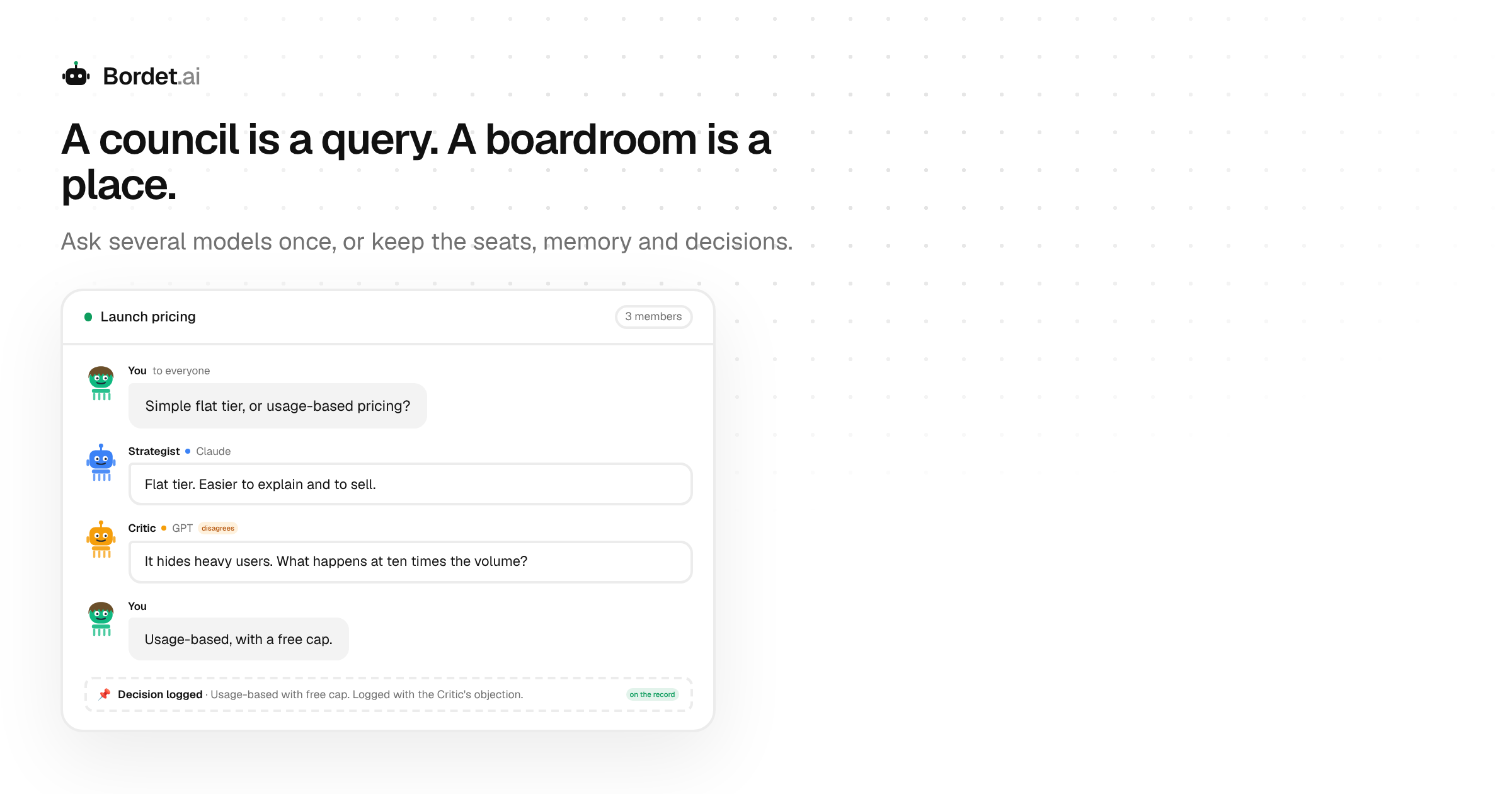
Say you are choosing between two pricing structures for a launch.
You put the question to the room. The Strategist argues for the simpler structure. The Critic, on a different model, says the simpler one hides the cost of heavy users and asks what happens at ten times the volume. The Analyst runs the numbers. You read all of it, and you can see which objection moved the result.
You pick one. The decision goes into the log with the reason and the objection that was overruled. Three weeks later, a teammate asks why the free tier has a cap. The answer is a search away, and it is written in the words of the people who made the call, not reconstructed from memory.
None of that needs a different question. It needs the room to still be there.
Where a council is enough
Plenty of questions are one-off. Which of these two libraries has better support? What does this clause usually mean? For those, a council is quick and cheap, and we would not tell you to set up a room.
The line is whether the answer is an input to something that continues. If it is, the useful output is not the comparison. It is the decision, the reason, and the dissent that came with it, kept somewhere the next session can read.
Cost is the other half, and it is simple here. Credits are metered per turn and the balance is a hard cap, so a room with four seats never produces a surprise bill. Or bring your own keys and pay the labs directly. BYOK is free in beta.
The short version
A council tells you what several models think right now. A boardroom remembers what the table decided, and who disagreed.
Open a boardroom, give each seat a role, and put all of them to work.
See it for yourself
Open a multi-LLM boardroom and put your AI team to work.